Performance first
The box should invite playing, touching, changing, and reacting. It should feel like a performance tool, not a background generator.
One musical image behind the project is a single beautiful sound, for example a minor 9 chord, that modulates so gently that after a minute you stop noticing it, and after an hour you realize it has been there the whole time.
Not a static drone, but a living state that creates a deep sense of calm.
The firmware got there on 18 July: one COLOR knob per part stacks tones out of the scale that's already running, so a chord is never selected from a list — it grows out of the note that was playing.
A 90-second sketch of that chord space, recorded on my Eurorack system — the sound world this instrument is aiming for.
What it is
The core idea is a small standalone ambient instrument, sized to be picked up and played. Its central feature is a deep modulation system that brings simple lines to life — synthesis and samples are the material, modulation is the instrument.
The question I'm chasing: how little change does a sound need to stay alive for an hour? Not pure randomness — controlled, polyrhythmic variation. Classic LFOs sit alongside stepped, semi-random modulation in the tradition of Mutable Instruments Marbles: stable when needed, drifting when desired.
Example: a 16-step sequence against a 12-step modulation pattern. The modulation can stay stable, slowly evolve, or generate controlled variations.
The box should invite playing, touching, changing, and reacting. It should feel like a performance tool, not a background generator.
I am especially interested in feedback as musical material: sounds that feel alive, unstable, and responsive while still being playable.
Version one held to one or two generative tracks, the modulation system, and a handful of performance controls — that alone was, and still is, the instrument. Sampling and a master section were stretch goals, and both have since arrived: two sampler decks with live resampling and a slice-groove engine, plus a stereo-linked master limiter with drive and per-part dynamics.
Running today
No longer a sketch, and no longer only a spec: the firmware runs, is tagged and public at github.com/mcbronkowitch/fireflow, and you can play it today as a VCV Rack module. Two parts, each driving five independent modulation lanes from one set of macro controls — with a motivic melody engine on one knob, chords on another, and one layered center fader. What’s left is the instrument itself: a Daisy Patch Submodule prototype, with pads, LEDs and a panel that still has to be drawn.
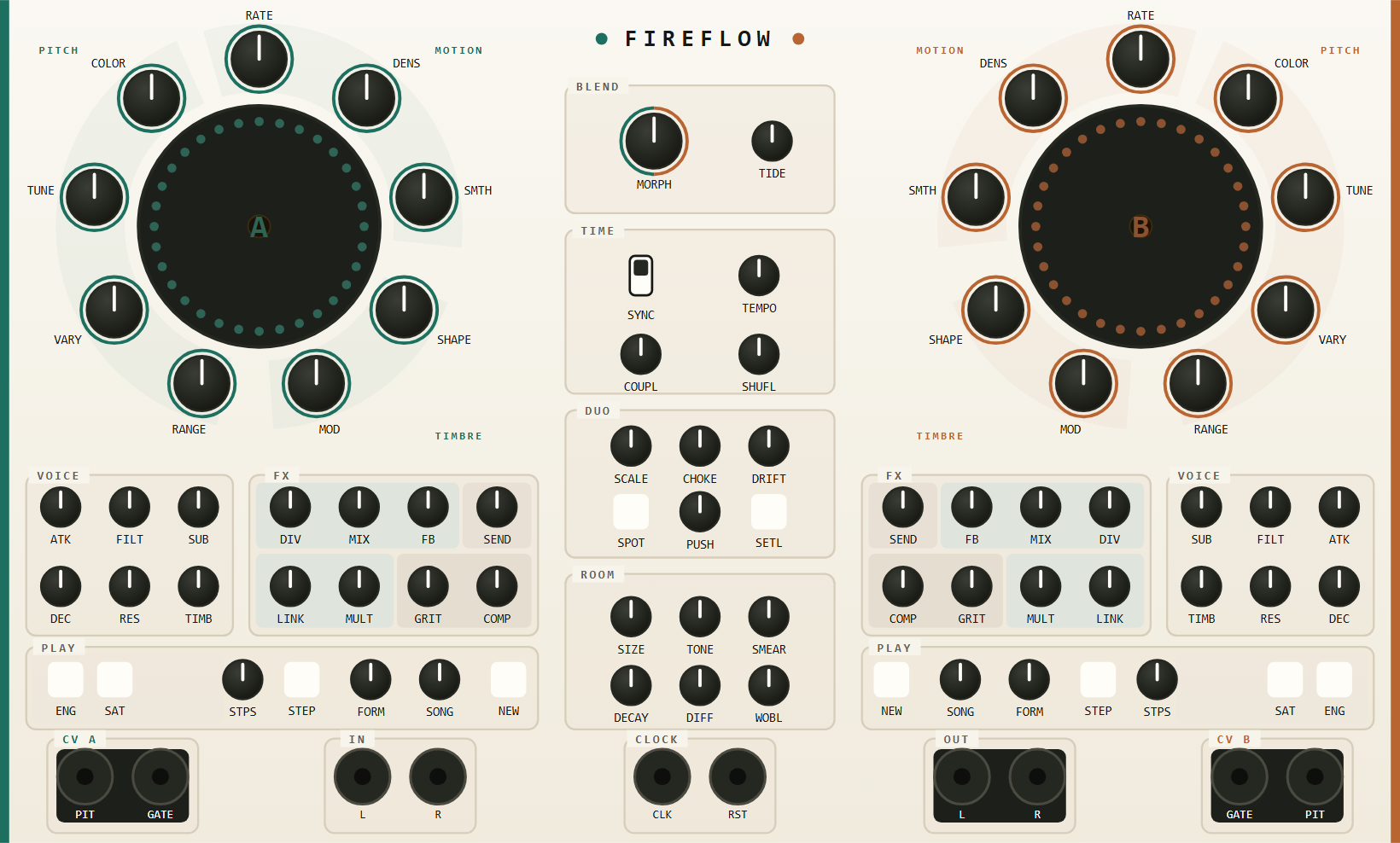
Main features / what the module does today
One macro surface — rate, shape, density, smooth, range — sits on top of five independent lanes, one per target. Each lane has its own phase, its own random stream and its own dice, running at a fixed musical ratio of the master rate. The melody can rise while the filter falls. One output driving every target would just move everything together: a tremolo, not an instrument.
Each lane runs one of three ways: FLOW as a smooth LFO, STEP as a stepped sequence, or ENTROPY, which grows, loops and erodes over time. The choice is per lane, not per part — so one target can hold steady while the one beside it comes apart.
A part points at a polyphonic synth voice, a granular texture deck, WAVE for glassy wavetables, BODY for struck and bowed resonance, or BBD — a bucket-brigade delay with no notes at all, whose lanes drive clock, feedback and mix instead of pitch and timbre. All five sit behind the same lanes and the same voice row: no knob goes dead when you change the engine.
MORPH blends the two parts, COUPLE sets how much they feel each other, DRIFT is the slow weather, and SPOT is the stumble the instrument is named after: one tap and every lane gets its own random kick. SETTLE is the way back — drift and every random walk ease to zero over a second, until the instrument is doing what the knobs say again.