Workshop Journal · Chapter 04
Making it playable
Groove instead of dice, CHOKE, a cutoff you can grab
16–17 Jul
16 Jul 2026
One switch, two worlds
A humbling Rack lesson: nobody new to the instrument could say what “sync” meant — and they were right, because it didn’t mean one thing. COUPLE at full while the two RATE knobs read unrelated numbers; a tempo knob hiding between the reverb controls; a near-invisible three-way toggle per part. Two time systems that had never been introduced to each other, and the player paid for it. So the sync story got rebuilt around one prominent switch: SYNC, in a new TIME group right under MORPH, next to the tempo and the couple knob it shapes.
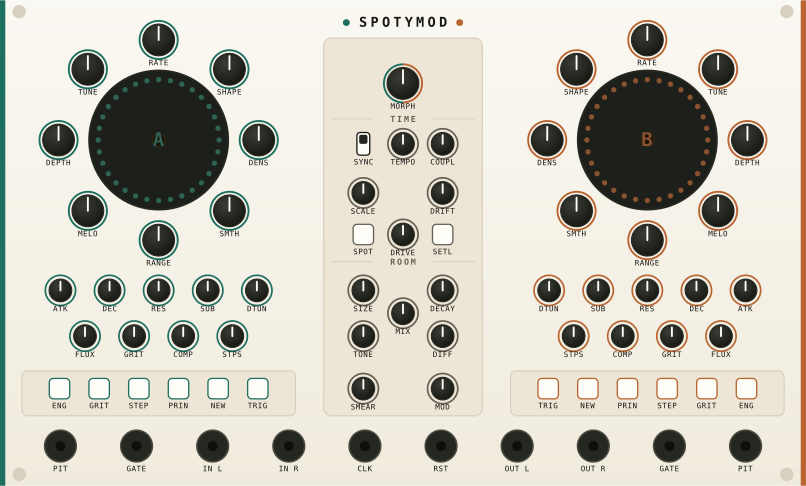
Synced is the grid world: both melodies lock to the tempo — and, new, to the actual downbeat of an external clock — while RATE snaps to a musical ladder with dotted and triplet steps between the straight ones. COUPLE stops touching the melody entirely and becomes a texture control: full is lockstep, backing it off lets the modulation breathe apart while the groove stays put. Free is the organic world it always was, with one addition — past half, COUPLE grows “grid gravity” and the locked pair gets pulled onto the nearest musical division, elastic like a shuffle, until at full it lands exactly where the grid world lives. Flip the switch there and nothing jumps. The recording is a live session in Rack on v2.1.0 — synced play first, then the textures let loose.
16 Jul 2026
A groove instead of a dice roll
The gates used to fall out of metric weights — turn density up and you got straight eighths, a metronome wearing a synth. Now every phrase composes its own rhythm: its notes are ranked once, syncopations push ahead of the beats they anticipate, and DENSE simply decides how deep into that ranking the part plays. Turning the knob adds and removes notes from the same groove — it never re-rolls. Notes carry composed lengths now too, so the GATE jack finally speaks in ties and rests instead of five-millisecond blips.
16 Jul 2026
A melody allowed to fidget
If the rhythm is part of a phrase’s identity, when may it change? The MELODY knob (RENEW ↔ LOOP ↔ GROW) answers with zones: the inner quarter varies only the notes — the groove stays frozen, a loop you can trust. Past the quarter each cycle rolls one quiet dice, and at most one thing about the rhythm mutates: two ranks swap, a note stretches, an off-beat flips onto its beat. Structurally guaranteed legal, so DENSE keeps its promise while the pattern slowly walks away from where it started.
16 Jul 2026
Only one may speak
Born at the modular bench: sometimes the two decks should answer each other, not talk over each other. So the centre strip grew CHOKE — middle is off, and each direction has two snapped steps. First step: the yielding deck skips its notes while the other holds a note — the ringing tail is free space. Full tilt: it waits as long as the other is audible at all, decay included. Skipped, never delayed — the melody keeps walking underneath and steps back in on the next free moment, ringing tails always finish, and a droning deck bows out gracefully and fades back in when the floor is free again.
A confession from the play-test: the first version was clever — a probability zone, a window that grew with the knob — and in Rack it felt broken. Random ducking reads as a bug, not a feature. Five snapped states replaced the curve the same evening, and suddenly the knob explains itself. Building in Rack first keeps winning.
17 Jul 2026
The cutoff you can grab
A synth with a filter and no cutoff knob. The frequency belonged entirely to the super-modulator — it moved when the FILTER lane moved — and RES sat next to it, seasoning a cutoff nobody could set by hand. So the voice row grew a sixth knob: FILT, a bipolar trim that sums with the lane. Left closes the filter with the resonance singing along — and keeps going, past dark, into actual silence. Right swings it open beyond wherever the modulator parked it. Three promises hold no matter what the lane is doing: full left is silent, centre is bit-identical to before, full right is wide open.
The first design had a highpass on the right half — cut in review, not for sound but for arithmetic: eight extra filters running forever on the future hardware, all for a nice-to-have. The shipped version is less DSP, not more: an offset in the lane’s own space, and the dive into silence rides the level smoother the engine already had. Zero new parts. Because knob and lane share one sum, the modulator can even play the fade — park FILT half-left and the lane dips the part under the surface and lifts it back out. Shipped — it’s in the current build.
17 Jul 2026
How wild, how fast
“Modulation first” was the founding idea — and yet the panel had no handle that said how much or how fast without dragging the melody along. DEPTH scaled everything, melody included; RANGE multiplied on top of it; speeding anything up meant speeding the clock up. So the knobs got sorted into honest jobs. RANGE is now only how far the melody roams. MOD (née DEPTH, per deck) is only how much the sound moves — at zero the timbre stands perfectly still while the melody keeps playing, note for note, bit-identical. And a new centre knob, TIDE, sets how fast the texture of both decks churns — a quarter speed to four times, snapping to musical ratios when synced — while the melody’s clock never moves. One knob answers “how wild”, the other “how fast”, and neither touches the tune.
Then the play-test caught the real story. The new MOD knob sounded like a tremolo diving into silence — and the code explained why: in the Rack build, three of the five modulation targets had been booting mute all along (their pads arrive with the hardware), so “how wild” was mostly just volume. Two fixes landed the same afternoon. A floor: modulation may duck a part to 40% of where you set it, never into nothing — it breathes, it doesn’t vanish. And modulation first is now the shipped state: all five targets wake up active — timbre morphing at full depth, the cutoff breathing on a shorter leash (the big sweep stays on FILT), stereo motion that moves without pumping. For the first time, turning MOD up moves the sound. Shipped — grab the current build.