Workshop Journal · Chapter 13
The plate
Glow comes out of the tree and half of it turns out to be a front panel for a module nobody will build — then the modulation layer finally learns to go slow, a knob that never had a behaviour gets one, the panel groups draw their own shapes and the result looks like a children’s toy, and the patch you boot into is a different instrument again
14–15 Aug
14 Aug 2026
Half of it was one file
Glow and the terrain layer underneath it came out of the tree today, which is exactly what the last entry said would happen. Forty-three thousand lines, gone in one commit.
Half of that was a single file: the front panel of a module nobody is ever going to build. The other half held the layer that had slowly worked out, by ear, what this instrument is supposed to sound like — so that part got written down before it went. It is the only thing I kept.
15 Aug 2026
Nothing here could slow down
I have wanted the modulation to go slower for months, and it turns out there was simply no knob for it. Three of them look like they should do the job. None of them does.
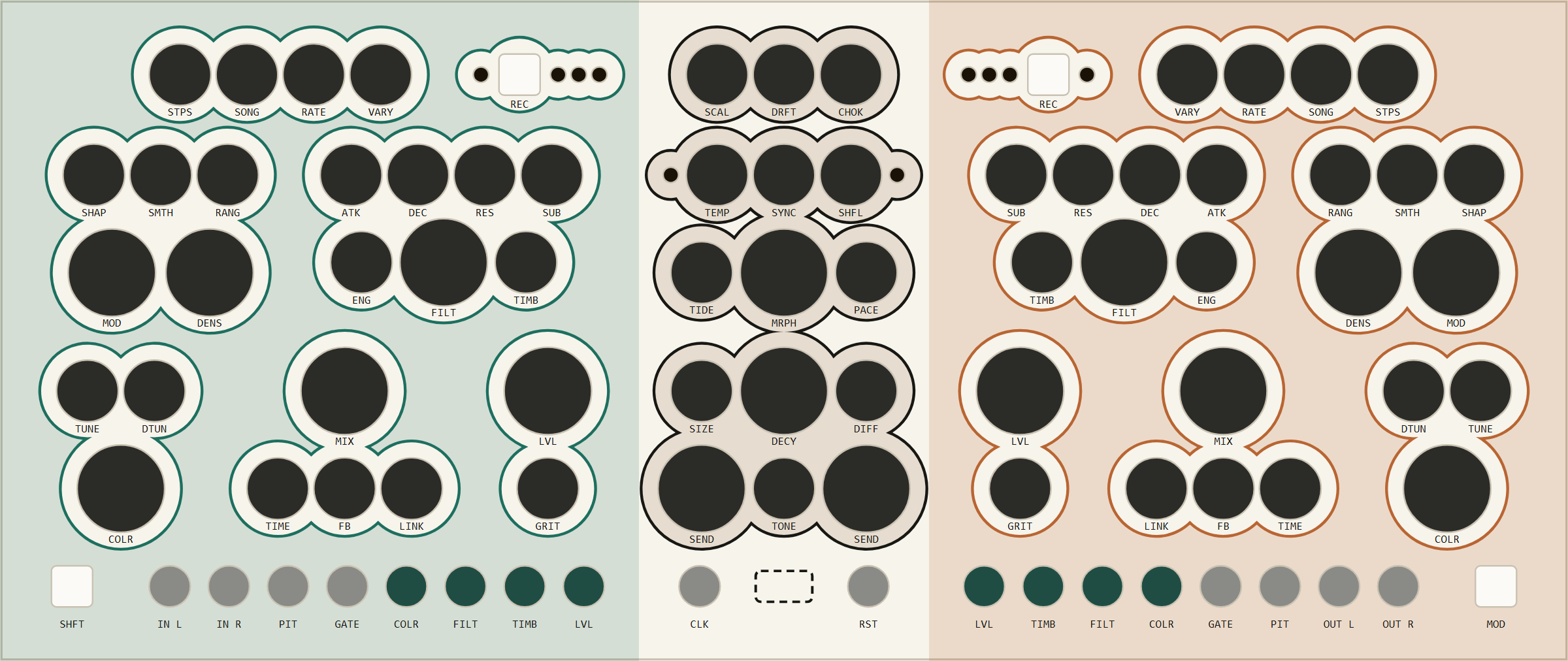
So now there is one, and it works on everything at once. Turn it left and a wobble that took eight seconds takes four minutes; turn it right and it hurries. Dead centre it does nothing at all, deliberately — a control that bends everybody else’s time needs one position where it provably isn’t there.
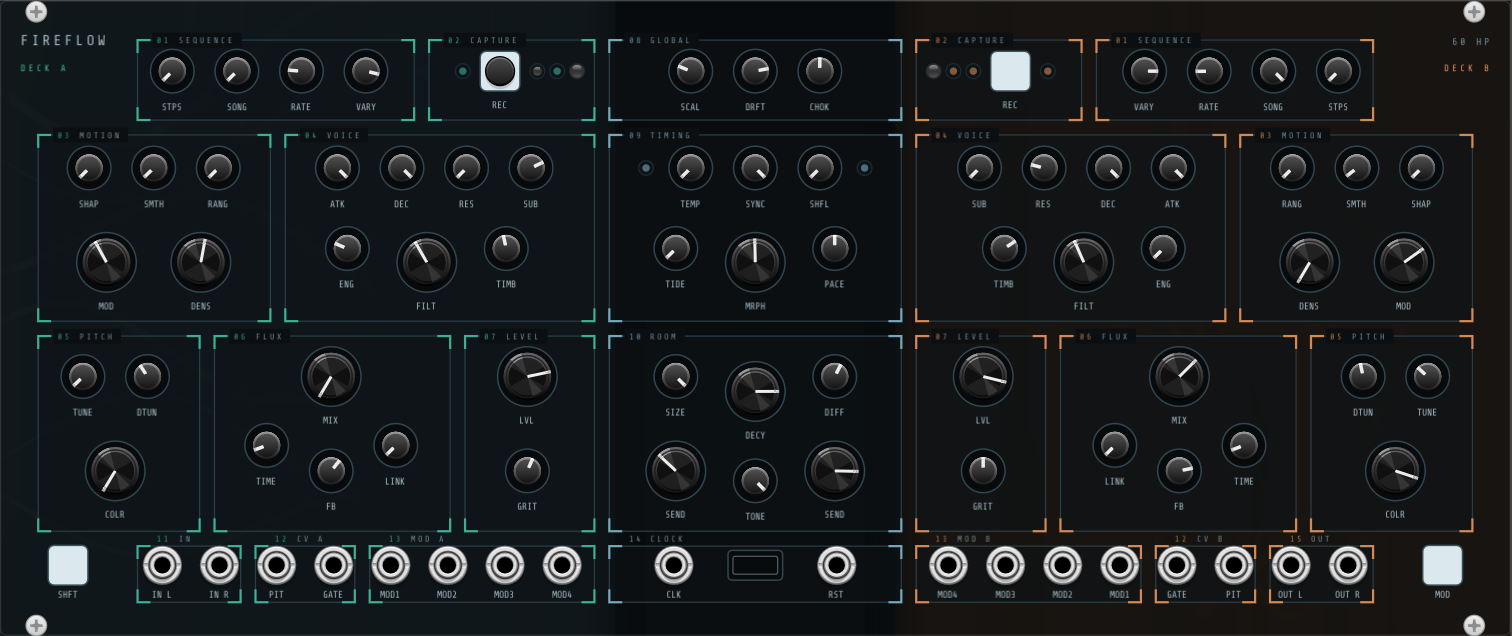
It sits on the drawing below, right next to the blend. That is the plan, redrawn today to make room for it. The generator that turns the plan into an actual plate hadn’t caught up yet when this was made.
15 Aug 2026
The knob had no behaviour
Smoothing was measured in seconds. The things it smooths run anywhere from thirty wobbles a second to one a minute, so the same setting did something different in every patch. The knob had no behaviour of its own — only a per-patch one.
It is measured as a fraction of whatever it is smoothing now. Same knob, same setting, four wildly different speeds, one answer.
15 Aug 2026
Nobody drew these shapes
The outlines around the groups are not drawn. Each group’s knobs get puffed up a little and merged together, so the shape is simply whatever those knobs happen to make. Then each deck got a colour of its own.
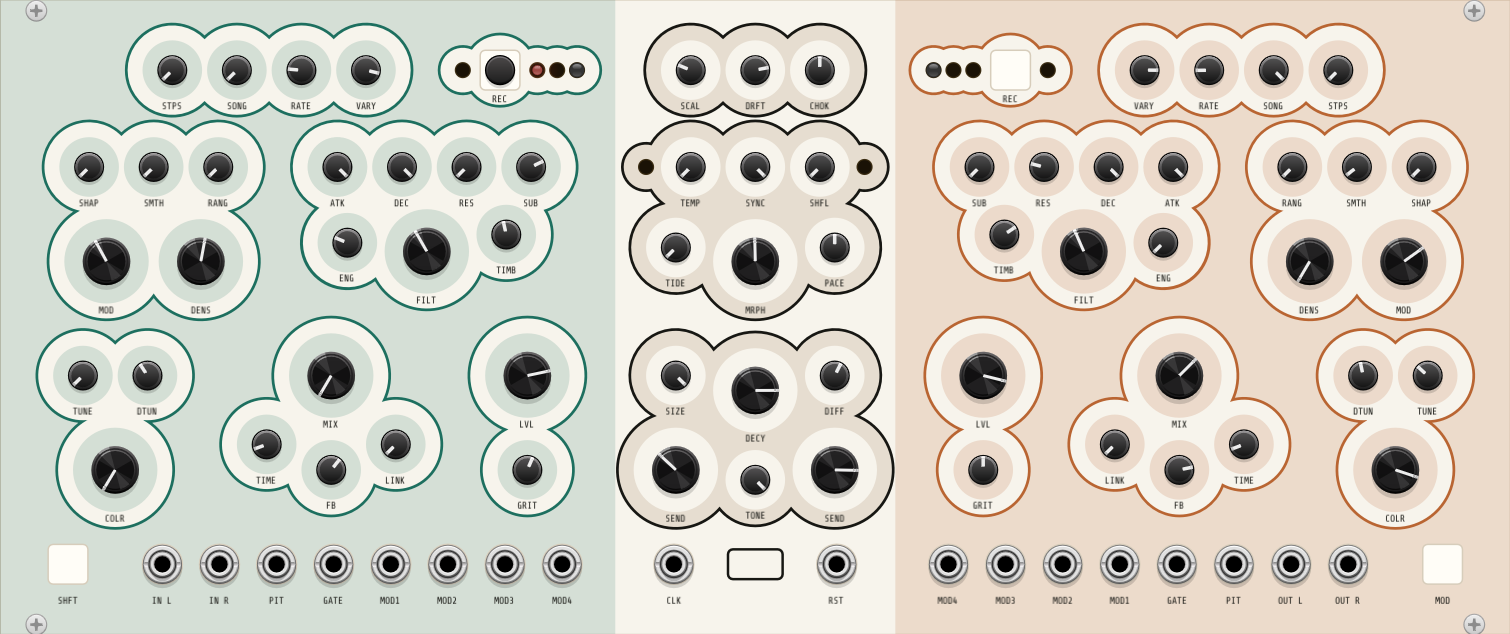
Which is how the instrument ended up looking a bit like a children’s toy. Pastel, and clouds. I am going to leave it exactly like this for a while and see how it wears — the shapes are at least honest, and I would rather have honest and slightly silly than handsome and arbitrary.
One part of it is less finished than it looks. The four sockets under each deck used to carry the name of the thing they would control; once the groups became blocks they could no longer sit under those knobs, so they are just numbered now. Nothing is wired behind them yet, the two buttons in the far corners still do nothing at all, and nobody has held this plate. It is a picture on a screen.
15 Aug 2026
It boots as something else again
Nobody retuned the starting patch. The smoothing knob changed its meaning underneath it, the stored values were converted so it would still sound like itself, and then the new speed control arrived. Same file, different instrument — the second time that has happened this month.
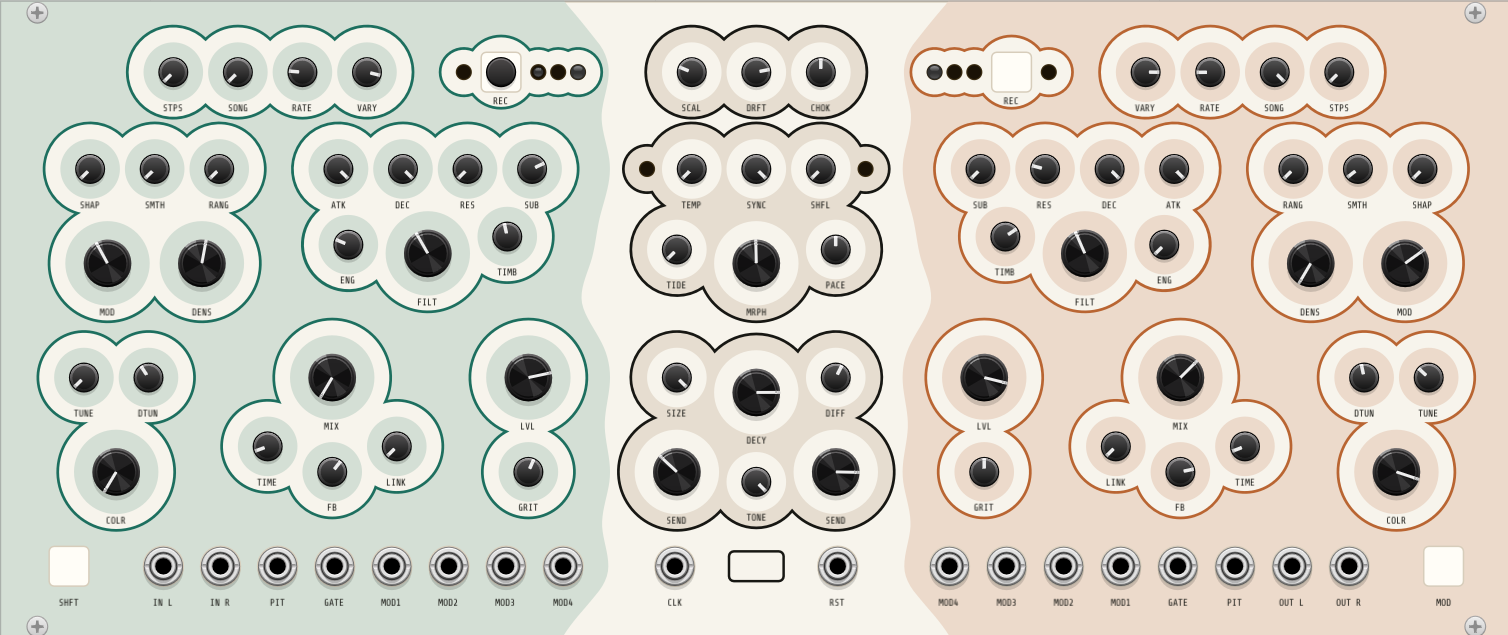
And a word about the colours, because somebody has to. The zone edges went soft in this pass as well, so the three decks now flow into one another instead of meeting at a line. Sage, cream, dusty copper, every corner rounded off — it has stopped looking like a synthesiser and started looking like a still from a Japanese animated film. I genuinely cannot tell yet whether that is a problem.
15 Aug 2026
The plate went dark
The pastel clouds are gone. What sits there now is closer to a technical drawing: a near-black plate, one cool deck and one warm one, hairlines where the soft blobs used to be. And it stays a draft on purpose. A drawing that still looks like a drawing can be pushed around all week without any single change reading as an accident — the moment a panel looks finished, every move on it looks like a mistake.